

Where’s the Protestant Work Ethic?
If you act upon your ambition, something really could happen.


I recently shared with my students Billy Collin’s Poem “To My Favorite 17-Year-Old High School Girl.” Watch the recording of his reading. It’s a cutting poem.
Ecclesiastes 7:10 warns us to avoid thinking of history as better than the present era, yet reading biographies of the Puritans, let alone the biographies of anyone before our century, has made me feel emasculated. It is here, that I ponder. Is there something different about our modern men? There is something different about the perceptions of these men, at least. A modern Plutarch’s Lives could be written. But who would write it with dignity?
Alexander the Great, King David, King Solomon, Brian Boru, Godfrey of Bouillon, Martin Luther, Oliver Cromwell, Theodore Rosevelt, and pages upon pages of names of men of renown make a modern man think of himself as worthless. How can we aspire to anything great in the age of the birth dirth, mobile gambling, cannabis, and feminazism?
What makes a man a Samson instead of an Abimelech?
The challenges to become a man today are probably no different. But they are suppressed. In the 80s, when George Gilder released his Men and Marriage, there was utter hatred for his Creation Mandate emphasis. Gilder said that man achieves progress because he has a wife and kids at home and must innovate and do enterprise to provide for them, thereby advancing civilization. Single, free-loving men cannot do this. According to Gilder, the male sexual cycle must be submitted to the female sexual cycle. If the male sexual cycle dominated, the world would be nothing but gangs. Pretty great stuff. But he was hated.
Gilder is speaking universally in the book. Yet, he is also speaking from a perspective that is waning in the west—the Protestant Work Ethic. For those who’ve never heard of the term, it is Calvinistic. America largely invented the idea. If you go to any town, you will see the remnants of it, but the Puritanism of New England and the Dutch Calvinism of West Michigan were particular powerhouses of the stuff.
The Protestant Work Ethic is the byproduct of faithful Reformed Christians coming to the states, as well the First Great Awakening. These early American Calvinists did ambitious things in the U.S. founding because they had a deep sense that their election to salvation meant they were to be fruitful in all parts of life. This starkly contrasted with the clericalist culture of Roman Catholic countries. Aaron Renn writes some helpful stuff on this topic.
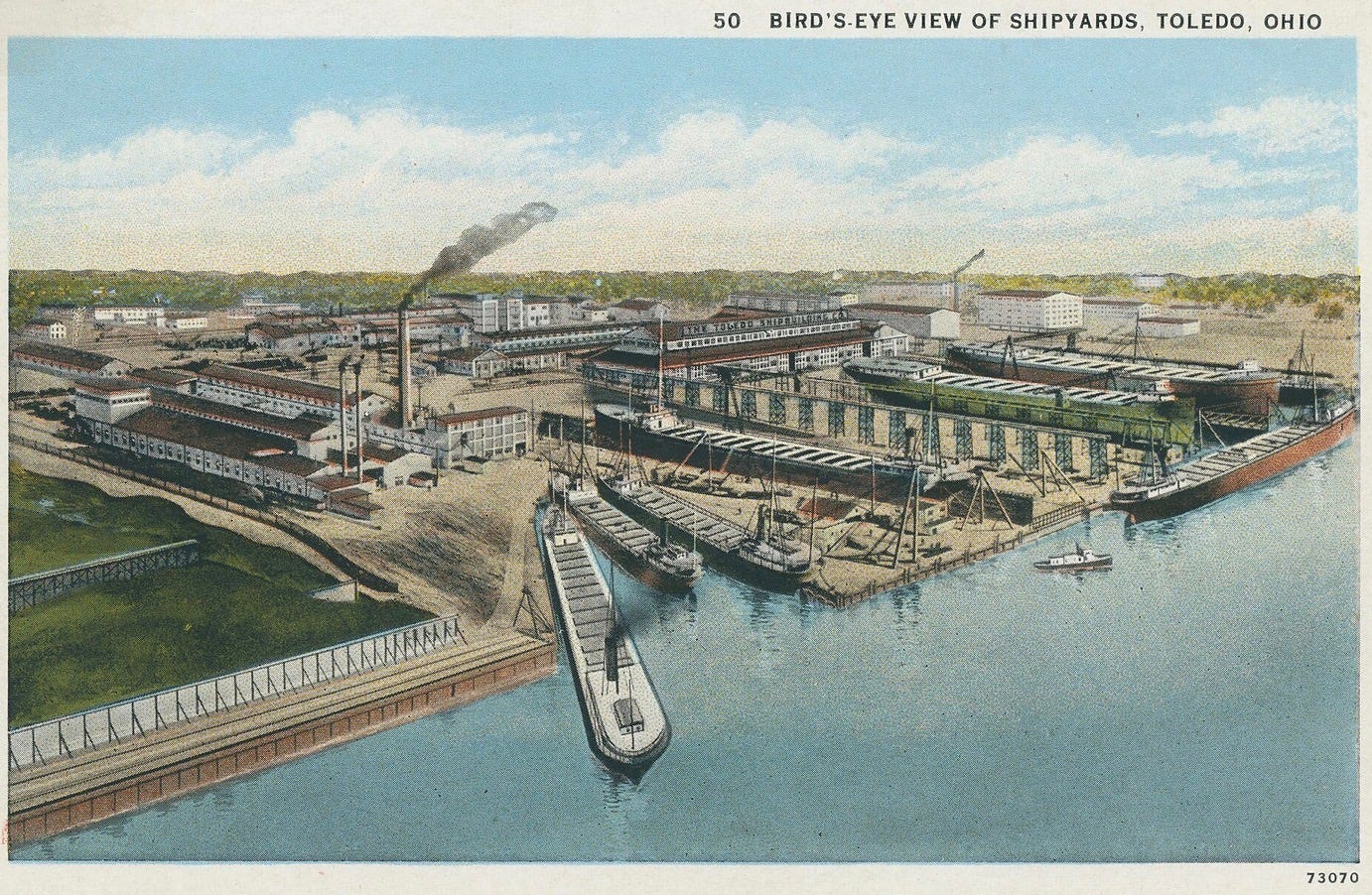
But this ethic became American over time, so that even heavily Roman Catholic towns, like Toledo, had a Protestant Work Ethic that guided the nation to build skyscrapers, railroads, and really the modern industrial world. But that ethic is fading since Protestantism is fading. Only heart change will reclaim it.
Roman Catholicism, as it stands today, will not help us out of our birth dirth and lack of ambition. Though I haven’t read it yet, I’m indebted to concepts from the papist Joseph Pieper. A fellow grad student of mine explained Pieper’s concept of leisure to me. I was quickly won over to it. Though titling a book Leisure: The Basis of Culture sounds like it goes against the Protestant Work Ethic, it actually is the groundwork of it.
Monasticism really helped with our work ethic. In monasteries like St. Columba’s on the Isle of Iona, the West was preserved through men taking the time to read, think, and write. Their “leisure” was their ability to create. They weren’t burdened by warring clans (until the 9th century). They weren’t hunting constantly to stay alive. They had the time to think. These men saved important texts that shaped the West. Yet, monasteries weren’t only cerebral. They were the training grounds. Men came to grow before going out into the mission field, venturing into unknown, pagan lands. It’s this spirit of adventure that extinguished by the time of the Reformation, when the Church had grown lethargic.
Then Protestantism renewed that spirit of ambition. By now, she’s lost it.
Putting aside work ethic and leisure and what’s gone wrong, look out your window. As I’m writing this, it’s raining outside. The ground is dank with wetness, the grass is saturated with emerald life.
Think. The earth under our feet is so rich with life that if I take a seed and put it in the ground, with little effort it will grow into a tree.
If you can, go for a walk tomorrow. Look at all of the houses, the bushes, the blades of grass, the telephone poles, and the trees and notice they are pointing heavenwards. The ground beneath your feet as you walk is charged with the elements necessary to grow trees that reach up and spread their branches like spindly fingers. God has not only built fruitfulness in His creation, but faith, ambition, and man’s will. How many of us who have an idea to do something like build a product to sell, create a garden, or write a book actually do it? Here’s the thing, you can.
Ray Bradbury once said in an interview that no one does anything. When he was younger, Bradbury loved the radio. He decided to go down to the station and ask if he could get a job there. The station had him do menial tasks like get cigarettes and coffee for the staff and take out the trash. But within a few weeks, he had a segment on the air.
Bradbury’s right. We don’t do anything. We’ve lost the Protestant Work Ethic.
Toledo is a city that loves leisure. The pickleball kind. She doesn’t call her young men to build or tell them they are needed. As Lewis said, “We castrate and bid the geldings be fruitful.”
Young man, your city needs you. Toledo needs you. If you want to plant a garden do it. Scripture warns about the dangers of ambition with men like Nimrod, but that topic is for another time. Nuance can be tiresome.
So, build something. Augustine said to honor God and do as you please. The “do” part is important.
God has given us a part in His creation to be sub-creators who enact our wills on the world, and when we do, glorious things happen. We are the only reason things are built today “like they were in the past.”
In Joshua 14, Caleb, the giant slayer, is an example to us when he says, “Now then, give me this hill country about which the Lord spoke on that day, for you heard on that day that Anakim were there, with great fortified cities; perhaps the Lord will be with me, and I will drive them out as the Lord has spoken.”
Charge the hill.
Novel
Dandelion Wine by Ray Bradbury
Nonfiction
The Men Who United the States by Simon Winchester
Poem
“To My Favorite 17-Year-Old High School Girl” by Billy Collins
Short Story
“All Summer in a Day” by Ray Bradbury
Essay
“Mr. Razzle Dazzle Turns 150” by Jonah Raskin
Audiobook
R.C. Sproul: A Life by Stephen Nichols
From the Pipeline
My recent pieces of the month.
Michigan Enjoyer
Toledo sounds like Peterborough.